All posts by utdblogger

4 Services that Universal Taxi Dispatch Provides

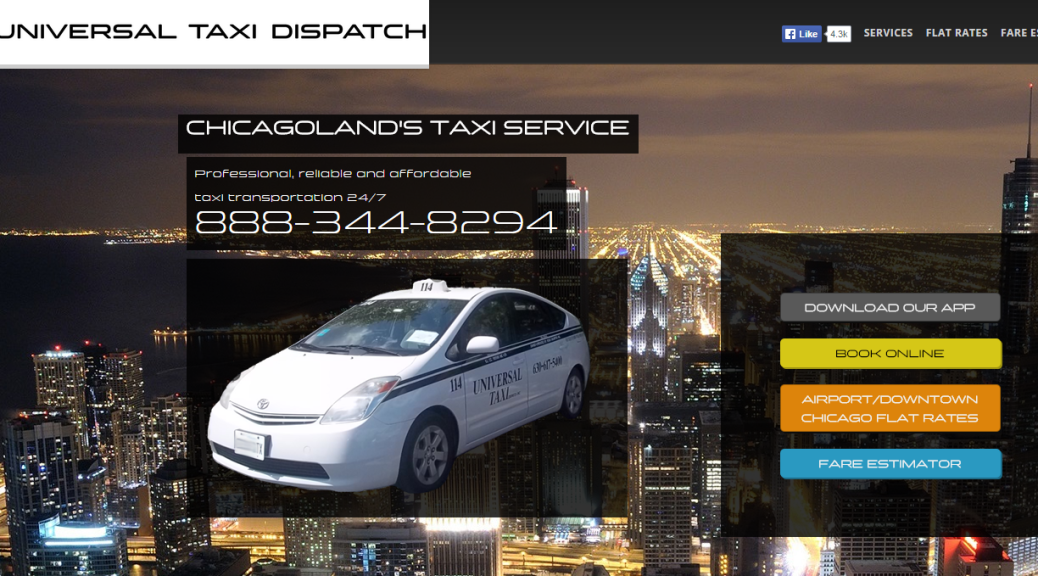
When looking for a taxi service to patronize, I always think that it is a good idea to look for one that provides more than just the basic services. After all, I want to be assured that the taxi service I call will be able to serve my needs and make life easier for me. One service in particular has caught my attention: Universal Taxi Dispatch, a taxi application that operates in Chicago.

Universal Taxi Dispatch

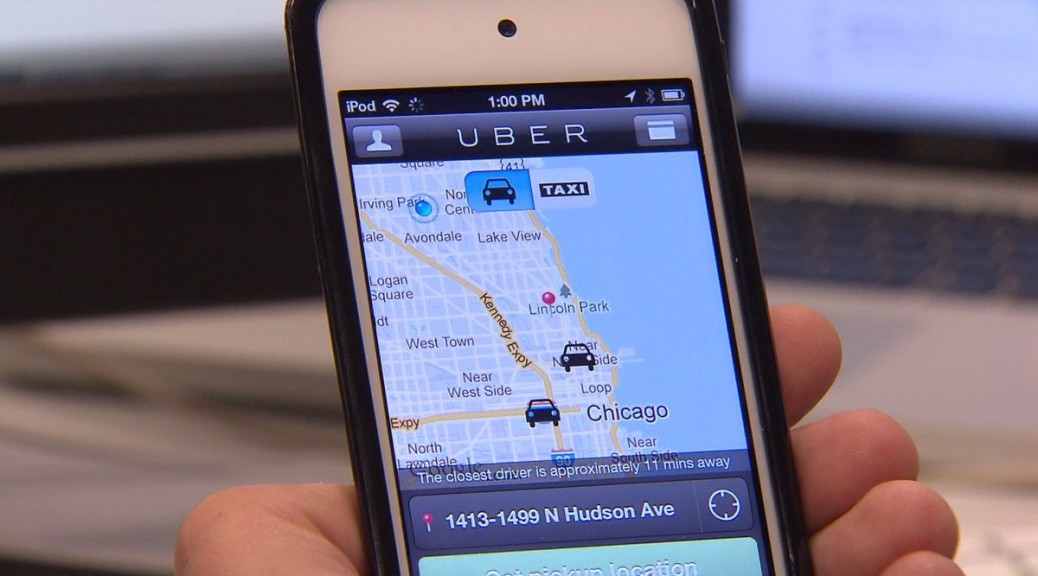
Now, the first thing I want to say about this is that I love how easy they are to call. The company came up with an app that allows people to call them and get a taxi to where they need it. I think that’s pretty nifty and this app saves me a lot of time from having to wait by the curb. In fact, it reminds me of one of those rideshare services, only I like this one better than the others since I know they’re professional cabbies regulated by the city.

Think about what you know about cabs – you hail them, let them take you from point A, and pay them after they drop you off at point B. However, this company does so much more than that and I want to share these additional features with you.

  • Airport services – The company services both Midway and O’Hare airports. It is very easy to get in touch with them. All you need to do is pick up your luggage and give them a call so they know where to pick you up. You will also get a taxi number. Now, airports are very busy places so you need to make sure that you keep an eye out for the taxi number that was given to you to make sure you get in the right cab.
  • Package delivery – I was so surprised when I found out that this taxi service actually delivered packages. They have a great team of drivers and different types of vehicles to accommodate packages of all sizes. The best part is that they deliver the packages within the day so it really cuts down on the delivery time.
  • School ride program – For those people who have kids, Universal Taxi Dispatch offers a safe and efficient way for your kids to get to school. They have a dedicated manager for this and you can rest easy knowing that your kids are in the secure hands of experienced drivers that will get them to school on time.
  • Corporate accounts – Corporate workers are busy folks and this is where the company picks up the slack. Their corporate accounts ensure that employees and clients alike are transported into meeting venues and events in a fast and safe manner.

As you can see, these services make this company so much better than the rest. They really know what their clients want and they do their very best to deliver. I must say that this has to be one of the best cab providers in Chicago.

Is Uber Violating Chicago Laws?

If there is one hot topic in the city of Chicago, it has to be the issue between the local taxi industry and the ridesharing companies like Uber and Lyft that are slowly, but surely,  taking over the streets of the city. We here think that a little competition is healthy but it seems that some ridesharing services are not just bent on competing but also have the potential to annihilate the local taxi business. This, of course, has everyone up in arms and this includes the local government in the city. This begs the question, if Uber is so good, why do officials seem to be against it?

The Uber Laws

The thing to remember here is that Uber just came to Chicago last 2011 and quickly became rising rock star of the roads. This, of course, caused some panic among cab drivers. And with the taxi industry being an important part of the Chicago economy and landscape, the government had to step in. We here at Universal taxi suppose the government could just kick out the service or ban them from the city but they cannot do that unless the ridesharing services break the law.

Well are they breaking the law?

The thing with Uber is that their business model doesn’t exactly make them illegal but it doesn’t totally make them legit either. They do have some practices that fall in the shady, gray areas between what is legal and what is not. After all, there really is nothing against the law about hitching a ride from someone and paying them money.

The gray area though is proving to be troublesome for the ridesharing service and they have had some rough times in Chicago especially with their new UberX. This service is basically for amateur drivers who can go around the city and pick up passengers for money. Just recently, they were sued by a woman passenger who claimed to have been assaulted by an UberX driver. We say that it isn’t really the fault of the ridesharing service—at least not directly—but you can see where they would be in trouble. Granted, violence has long been a part of the taxi industry but what makes this troublesome is that UberX makes it much easier for amateur drivers to perv out their passengers. Uber falls outside of the regulations that govern local registered taxis and they have taken steps to ensure that such regulations are not enforced on them.

Another thing to add to the list of troubles for Uber is that the city has put a limit of 450 drivers for their services and the thing there is that number is to be shared with Lyft and another rideshare service that operates within the city. Also, the city has banned UberX drivers from going to the airports to pick up passengers so that is another constraint they have to deal with.

The Real Deal

At the moment, Uber hasn’t really broken any laws just yet but they are still on that shady gray area. However, for those that want the convenience of a rideshare but want to ride regulated vehicles, Universal Taxi has an app here that can help.

Why Taxis are Still Safer

Transportation is something many people need. Considering that not everyone has a private vehicle, there are still a lot of times when going out requires making use of public transportation services. There are crowded trains, buses, and taxis that offer more exclusive interiors and convenience. Each day, especially in big cities, a lot of people commute and taxis can be the best form of transportation for more than just one reason.

Safety and Privacy

One of the top reasons why taxis are still safer compared to other forms of transportation is the mere fact that you don’t have to share your ride with anyone else. I have had my own experience in dealing with trains that are too crowded or buses that seemingly have more people than it should. It gets quite tiring. I also have the tendency to feel too guarded when other commuters are around. You can never be too sure when someone might be a pickpocket who’s waiting for the right chance at your valuables.

Inside a taxi, you get more safety and privacy. You can sit away from the driver and enjoy the drive to and from work or anywhere you need to go without having to deal with a chatty person next to you or the awkwardness of overhearing less pleasing conversations. These may be quite petty concerns, but let’s face it—after a day of hard work, having a bit of peace and quiet on your way home would be nice, right? You also reduce your chances of getting pickpocketed in public rides.

Convenience

Compared to public modes of transportation, you can now easily hail a taxi by using apps like the Universal Taxi Dispatch app. You will no longer need to stand at the sidewalks and wait for a taxi to come. Just use the app and you can order a taxi and find it waiting for you in front of your house. Within minutes of ordering a cab, you can be on your way to your destination with no hassle. Furthermore, convenience also means not having to share the ride with over a dozen people. No need to stop anywhere you aren’t getting off at, and you can get to the place you need to get to just like you would in your own vehicle.

Professionalism

The drivers you will employ using the Universal Taxi Dispatch app are very professional. This is one of the things that contribute to the safety of each ride. The taxi drivers have been carefully screened and you can expect nothing but professional service from them.

You need them at this exact hour? They’ll be there. Do you have to go somewhere you don’t know? They know the Chicagoland area like the back of their hand and they can get you there on time. Are you from the airport and need help with your luggage? They can also assist you with that.

The convenience, privacy, and safety you can get from the professional services of cab drivers using this mobile app is amazing. I would recommend it to anyone who has a preference for safe and convenient modes of transportation.

How to Hail a Taxi Cab in Chicago

The streets of Chicago can get pretty busy and sometimes hailing a cab sometimes turns out to be an impossible feat for some. This does not mean that you’ll be left out on the streets without a ride to get to your destination, nor does it entail having to resort to getting rideshare services which could be a lot riskier. Sometimes you just have to know a thing or two about the best ways to hail a cab around the Chicago area.

Stick out your thumb.

Some people prefer screaming “Taxi!” at the top of their lungs while some prefer whistling. Unfortunately, these would only leave you breathless and hoarse, especially if you do it continuously. Some could say that they only wait for cabs whose lights are on, but most of the time, this does not work either as some cabs still leave their lights on despite having a passenger. The best option really is for you to just stick out your thumb at every taxi that passes as a hitchhiker would do when looking for a ride on the highway. It’s less tiring, and it gets you noticed every time.

Call the cab company.

Arrange for a pickup by calling the cab company. You can always get their numbers from directory assistance or by looking it up online. You can even schedule the pickup ahead of time, leaving you with less worries when it’s time for you to leave. This is especially helpful if you want to be picked up at a place where you’d have to rely on luck before a cab passes by.

Book online through the cab company’s website.

Most Chicago cab companies have their own websites, and most of them give you the option to book a cab online. So if you’re connected all the time, this is definitely one of the best ways for you to hail a cab. You just need to let the cab company know your location and your destination. You also have the option to book a cab in advance or request for a cab at that precise moment, and you will be notified if there is a cab available in your area.

Book through a taxi app.

Yes, cab companies are keeping up with the times. A lot of cab companies now have their own app where you can request for a cab no matter where you are. Universal Taxi for example, has their very own Universal Taxi App which you can download on your iPhone or Android phone and use anytime you’re having trouble hailing a cab. It’s fast, convenient, and pushing a few buttons on your screen will not be as tiring as having to wave and scream at every cab that passes by.

Cab companies understand the plight of Chicago commuters, which is why they find ways to make it as easy as possible to hail a cab. As long as you have the know-how and the right tools, hailing a cab in the middle of Chicago will be a trick you could master in no time.

4 Services that Universal Taxi Dispatch Provides

When looking for a taxi service to patronize, I always think that it is a good idea to look for one that provides more than just the basic services. After all, I want to be assured that the taxi service I call will be able to serve my needs and make life easier for me. One service in particular has caught my attention: Universal Taxi Dispatch, a taxi application that operates in Chicago.

Universal Taxi Dispatch

Now, the first thing I want to say about this is that I love how easy they are to call. The company came up with an app that allows people to call them and get a taxi to where they need it. I think that’s pretty nifty and this app saves me a lot of time from having to wait by the curb. In fact, it reminds me of one of those rideshare services, only I like this one better than the others since I know they’re professional cabbies regulated by the city.

Think about what you know about cabs – you hail them, let them take you from point A, and pay them after they drop you off at point B. However, this company does so much more than that and I want to share these additional features with you.

  • Airport services – The company services both Midway and O’Hare airports. It is very easy to get in touch with them. All you need to do is pick up your luggage and give them a call so they know where to pick you up. You will also get a taxi number. Now, airports are very busy places so you need to make sure that you keep an eye out for the taxi number that was given to you to make sure you get in the right cab.
  • Package delivery – I was so surprised when I found out that this taxi service actually delivered packages. They have a great team of drivers and different types of vehicles to accommodate packages of all sizes. The best part is that they deliver the packages within the day so it really cuts down on the delivery time.
  • School ride program – For those people who have kids, Universal Taxi Dispatch offers a safe and efficient way for your kids to get to school. They have a dedicated manager for this and you can rest easy knowing that your kids are in the secure hands of experienced drivers that will get them to school on time.
  • Corporate accounts – Corporate workers are busy folks and this is where the company picks up the slack. Their corporate accounts ensure that employees and clients alike are transported into meeting venues and events in a fast and safe manner.

As you can see, these services make this company so much better than the rest. They really know what their clients want and they do their very best to deliver. I must say that this has to be one of the best cab providers in Chicago.

Security Issues with Ridesharing Cab Companies

The security of our passengers tops the priority list of Universal Taxi. We acknowledge that every one of us in the company, from the management down to the cab drivers, has a responsibility over the lives of our clients. We take this responsibility seriously and take pride in finding more ways to ensure that every ride is safe and secure.

We aim to help Chicago residents and visitors take care of themselves. So here are three ridesharing security issues that every passenger must pay attention to.

The lack of a call to action for passengers to read the company’s terms and conditions.

This is one of the most common mistakes of consumers. At one point or another, we are all guilty of disregarding the Terms of Conditions of a product or service. But these conditions are there for a reason. It is for consumers to fully understand what they are agreeing to.

We can’t stress enough how important it is for passengers to read the terms and conditions of the ridesharing cab company. It’s important to realize that availing its service is very different from hailing a taxi across the street. When a passenger downloads the ridesharing app, by default, s/he agrees to the host’s terms and conditions. And if an incident happens, depending on the terms and conditions, the ridesharing cab company can be free from its obligation to the passenger.

The use of different cab companies and/or taxi app.

Time has changed.Nowadays, traditional taxi dispatchers have apps and mobile services. At Universal Taxi, we answer to conventional hailing of cabs or scheduling through the telephone. But we also provide a new service, the Universal Taxi App. This is our brand new app that helps us meet the needs of our app-loving clients.

We understand it’s natural for customers to test many service providers first before sticking to one. But changing from one company/app to another can open a huge security hole. This is due to the passenger’s personal data being transmitted to various companies. Once personal details like phone numbers are thrown to the digital world anyone can access the information. This is especially true if the security of the cab company is far from solid. This security risk can be prevented by sticking to one reliable cab company/dispatch.

The scarcity of information on how ridesharing companies get their drivers.

The rise of ridesharing companies and the luxury they bring can easily entice passengers. But there’s also the glaring fact that a passenger doesn’t have any idea how the cab company cross-checked its drivers. This reality is true for both ridesharing companies and taxi dispatchers. However, it’s scarier with ridesharing companies. This is because rideshare drivers usually know pertinent personal details about the passenger. This makes this security issue a privacy dilemma as well.

Yes, ridesharing is the “hot” thing right now. And many passengers choose it over the traditional taxi. But with all the controversies and security issues surrounding it, it’s a lot better to trust the neighborhood taxi dispatcher if you want safety first over anything else.

Are the Existing Rideshare Service Restrictions in Chicago Enough?

Rideshare companies like Uber and Lyft tool Chicago by surprise, creating an avalanche of issues within the city’s transportation system. As these rideshare services continue to take a huge percentage of the city’s commuters away from the cab companies, it was not surprising at all when cabbies decided to take action by filing suits against the city itself.

In response, the city decided to show how important the taxi industry is by coming up with ordinances not only to give cab companies a fair share of the market but to somehow regulate how rideshare services operate. Although you can hear the rideshare companies complain about the ordinance, they are considerably better off with it as compared to their probable state in case the original ordinance, which was drawn by Mayor Rahm Emanuel, was approved. Chicago’s rideshare ordinance is also relatively more lenient as compared to the state bill.

Under the Chicago ordinance, drivers cannot go beyond an average of 20 hours per week which is definitely better that the 18-hour limit that the state has placed. Drivers who want to go beyond the 20-hour cap may also do so, provided that they can find another rideshare driver who can help offset the hours by logging in less hours for the same week.

In terms of issues on passenger safety and security, rideshare services are also required to go through strict driver background checks and vehicle inspections. They are also required to have insurance coverage. This is one aspect that cab companies have always seen as their edge against rideshare services, as there was a time when virtually anybody can become a rideshare driver. This puts the passenger at risk considering that there is no assurance at all about the driver’s capacity to drive other people around.

Of course, given the fact that rideshare services would find this city ordinance to be better than the state bill, the mayor is still receiving a lot of pressure from these services. This is mainly due to the fact that the ordinance is not at all about safety and security. Instead, rideshare services sees it as a way for the city to limit the amount of competition that cab drivers are getting. After all, the 20-hour limit does not prove anything. There is no assurance that the driver would do a better job if they only drove for 20 hours or less.

Because of this, Uber has been dangling the offer of more jobs in front of the city. Interestingly, the rideshare service is not looking for any tax credits for this. They simply want the city council to cease from standing in their way as they promise to bring over 400 new jobs in the city.

With this ordinance combined with the Taxi Driver Fairness Reforms package that was passed in December last year, it is not surprising that rideshare services are calling foul. However, it should also be understood that cab companies have always been part of the city’s transportation system, and it is also unfair for them to be suffering from competition that offers the same kind of service as they do, but without the pressures and restrictions that they have to follow.

An Overview of Taxi and Limousine Guidelines in Chicago

Within the last several months, the feud going on between taxi and limo services in Chicago versus the new ride-sharing services have gotten really heated and both sides are pulling off the kid gloves.Yes, things are getting quite intense especially with campaigns from consumer advocates joining the fray and making sure that the public knows exactly what is going on in the ride-sharing industry and just how they are putting themselves at risk by agreeing to the terms and conditions put in place by companies like Uber.

In The Spirit of Fairness

It is good to know the guidelines that govern ride-sharing services like Uber but it is also a good idea to know the rules that are set in place for taxis in the Windy City. After all, just as there are dangers and risks in taking ride-share cars, taking cabs also has its fair share of risks. But that is just part of the game and as a consumer, you have to know what rules these cabbies live by so that you can protect your rights as a passenger.

If you want to make sure that your taxi riding experience in the city is as comfortable as possible, know some of the rules and guidelines that govern taxis and limos so you know your rights. It is not just the ride-sharing services that have rules, Taxis and limos have even stricter ones imposed by the city.  For instance, taxi drivers and their cars need to undergo a background check as well as an inspection from designated city officials. They also need to apply for and get approved for their chauffeur licenses. If the cab belongs to a company, that company needs to pay an annual fee of $25,000 for the license fee. Also, these companies carry about $333,000 in commercial liability insurance coverage. Compare that to ride-share services where just about anyone who can drive and has a car can offer their services, and you can see that perhaps riding a cab is the better option.

When it comes to paying, taxis in Chicago accept either cash or credit card. However, do note that there are times when the machine doesn’t work and some drivers are not very happy with customers who pay using plastic. If you choose to use your card, you can do the math and include a tip so that the driver does not feel too aggravated. Also, demand for a receipt; these drivers are instructed by law to give receipts.

Another thing you will want to know about riding authorized taxis and limos in the city is that they are obliged to drop you off in any area of the city. They cannot argue about this and any cab driver who says “no” is breaking the law and should be reported to the authorities. Ride-share drivers can pick who they want and do not want to pick up and can say “no” to passengers because they are not covered by city rules.

Taxis Online

If you like the convenience of ride-sharing but want the expertise of a licensed chauffeur, then Universal Taxi might just have the thing. The Universal Taxi app here http://www.universaltaxidispatch.com/app allows you to look for taxis just like ride-share apps.


Why Taxis Still Have the Edge Over Ridesharing Services

We here at Universal Taxi admit that there has been a whole lot of talk over the whole Uber, Lyft, and other ridesharing services thing and how they are taking away business from local cab drivers. However, we are fair and we have done our fair share of work into finding out just why people are going crazy over these services and why local taxi drivers are getting nervous. We admit that the idea of being able to summon a nice –looking car via a mobile phone has its appeal; we understand why people prefer ridesharing services to local taxis but people should also know that despite the growing number of ridesharing enthusiasts, taxis still have an edge.

What is the Edge?

Before we get into the nitty-gritty of the matter, it is first a good idea to have a look at exactly what ridesharing services have to offer. For one, they tend to be cheaper than local taxis and another is that they can be summoned with the use of a mobile phone- this is why it has been hailed so many times as godsend to travelers and drunken revelers alike. No more waiting at the curb and waiting for an empty passing cab because when you ping an Uber diver, that car is yours for the duration of the trip. Looking at it that way, you can say that these ridesharing services do spell the doom of local taxis but that isn’t necessarily the case.

These ridesharing services have a darker side to them and they are what ultimately gives the taxis an edge. You see, for taxi drivers to become legit taxi drivers, they have to make sure that they register their rides and get the proper licenses; these drivers are professionals which means they are, or most of them, are pros at driving. On the other hand, you have a ride sharing industry that is basically made up of anyone that has a car and wants to make pennies.

Uber, along with other ridesharing services claim that they are totally safe but face it, they do not give complete control over the people that drive Uber service cars and they have no real responsibility over what happens. This isn’t to say that Uber services and other ridesharing companies are not safe, rather it is a way of saying that there are no guarantees that they will take responsibility for any untoward incidents.

Another plus that gives local taxis an edge is that they have to go to emission testing centers and once they pass a certain limit, they are no longer allowed on the road unless they do something about their emission problem. Ridesharing services on the other hand are not required to undergo any such test and they can pretty much have a whole fleet of idling hummers on the roads just waiting for passengers.

That said, these things still give local taxi drivers an edge over ridesharing services and these should be carefully considered by those that are debating on the benefit of using local taxis vs. ridesharing services. For those that want the convenience of a rideshare service with the benefits of a taxi, you can check out the Universal Taxi app here.

RideScore 2014: Hired Driver Rules in Chicago And Other U.S. Cities

Visit R Street’s companion website, www.ridescore.org, for an interactive visual presentation of our regulatory scorecard.

Over the past several years transportaion on demand companies like Uber, Lyft and Sidecar have attracted millions of riders, rattled competitors and upended markets with the whirlwind forces of creative destruction. Their success has sparked heated debates in city halls across the country, as lawmakers grapple with antiquated transportation regulations and their many self-interested defenders.

Like many other peer-production businesses, the hallmark of these transportation network companies (TNCs) is disintermediation, or the removal of middle men who previously were necessary to facilitate connections. By cutting out taxi-fleet operators and license owners, TNCs aim to improve service levels and reduce prices. The direct connection of buyers and sellers can exploit underutilized capital in the form of a practically limitless pool of available drivers, thus helping to reduce costs for both consumers and providers.

In June 2014, Uber famously attracted funding from major investment firms that suggested a staggering valuation of $17 billion. While some observers have dismissed this number, even relatively pessimistic assumptions yield multi-billion dollar valuations. New York University Professor Aswath Damadoran estimates Uber is worth nearly $5.9 billion, which would be quite impressive for a five-year-old company that premiered its lower-cost UberX service (in which private vehicle owners pick up fares in smaller, more fuel-efficient vehicles) in select cities just two years ago.

The early results suggest, at minimum, that TNCs are having a significant impact on taxi usage. The San Francisco Municipal Transportation Agency reported that taxi trips dropped 65 percent over the course of just 15 months, from 1,424 per month to just 504.

In fact, TNCs may expand the market substantially, by convincing consumers to use the service at times they otherwise would not have called a taxi or limo. NYU’s Damadoran pegged the global car service market at $100 billion, suggesting that even if one TNC achieved a strong position globally, it would be unlikely to yield a valuation north of $15 billion. Such lofty numbers are justified by the projection that TNCs will expand use-cases for their services by drawing business from those who otherwise would rely on owned or rented cars, or utilize public transit, to satisfy their transportation needs.

As noted in an earlier R Street Institute policy study, this economic advancement brings with it the potential for huge amounts of added economic growth. The McKinsey Global Institute has estimated that social networking technologies, which include but aren’t limited to peer-production businesses like TNCs, could potentially add $1.3 trillion of annual consumer surplus in just four key sectors of the economy: consumer packaged goods, consumer financial services, professional services and advanced manufacturing. Given the vital role individual vehicular transportation plays in the global economy, it seems reasonable to estimate the impact of TNCs numbers in the billions of dollars.

Their success has not gone unnoticed, or unchallenged, by the entrenched taxi and limo industries in many localities. The policy response has varied wildly from one locality to the next, with some embracing the opportunity inherent in added competition and others seeking to shut it down before it ever takes off. Taxi drivers complain that TNCs are operating outside the scope of existing taxi regulation, in effect branding them “gypsy cabs” operating on the black market. They argue that embracing TNCs will erode market share for taxis, whittling away at revenue and employment in an already-turbulent business.

To remedy this, most entrenched interests have suggested requiring TNCs to submit themselves to the often ill-fitting regulations that currently govern taxi and limo service, despite major differences in business structure that call for tailoring an alternative treatment. Whether requiring them to purchase expensive supplemental licenses (often called “medallions”) or submit themselves to elaborate pricing mandates, the complex requirements taxi companies seek to impose on TNCs would severely hamper, if not eliminate, their ability to operate in most cities. While it is understandable that taxi and limo interests might resent TNCs for their leaner business model, the impulse to seek the expansion of restrictive regulations – rather than broader reforms that reduce the burden on all competitors – is worrying.

Taxi and limo interests do indeed shoulder heavy and, often, unnecessary regulatory burdens. The emergence of TNCs thus should be a golden opportunity to discuss full-scale, pro-consumer regulatory reform. Alas, in many cities, it has instead turned into a political battle, in some cases literally spilling into the streets through protests and traffic disruption by frustrated taxi drivers.

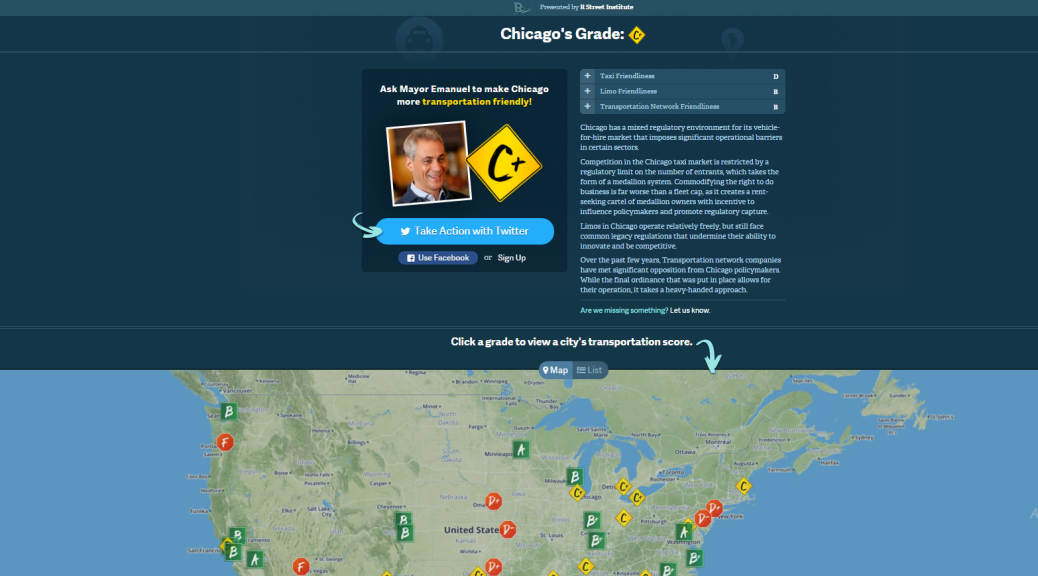
To paint a comprehensive picture of transportation regulation across the country, we embarked on an ambitious research project to grade 50 of the largest U.S. cities on their friendliness to the full range of for-hire vehicle services. The challenges relate to more than just TNCs, thus we also surveyed restrictions on taxi and limo services. In each city, we gathered information on key regulatory variables for TNC, taxi and limousine services, awarding numerical scores for each category that reflect deviation from a base score. Combining the grades for TNC regulatory friendliness, taxi regulatory friendliness and limo regulatory friendliness together yields an overall “ride score” that describes the city’s openness to competition in the market for hired vehicle services. Forty percent of the overall ride score derives from TNC friendliness, 40 percent from taxi friendliness and 20 percent from limo friendliness.

The scorecard is graded on a curve. If measured against an ideal system – one with the proper balance of public health and safety regulations that don’t unnecessarily restrict competition – most cities would fare poorly. Every jurisdiction has at least some rules of questionable utility. While none are perfect, some cities do a better job of fostering competition while protecting the public interest. This analysis is an attempt to identify them.