All posts by utdblogger

Truck safety ordinance moves Chicago towards a Vision Zero future

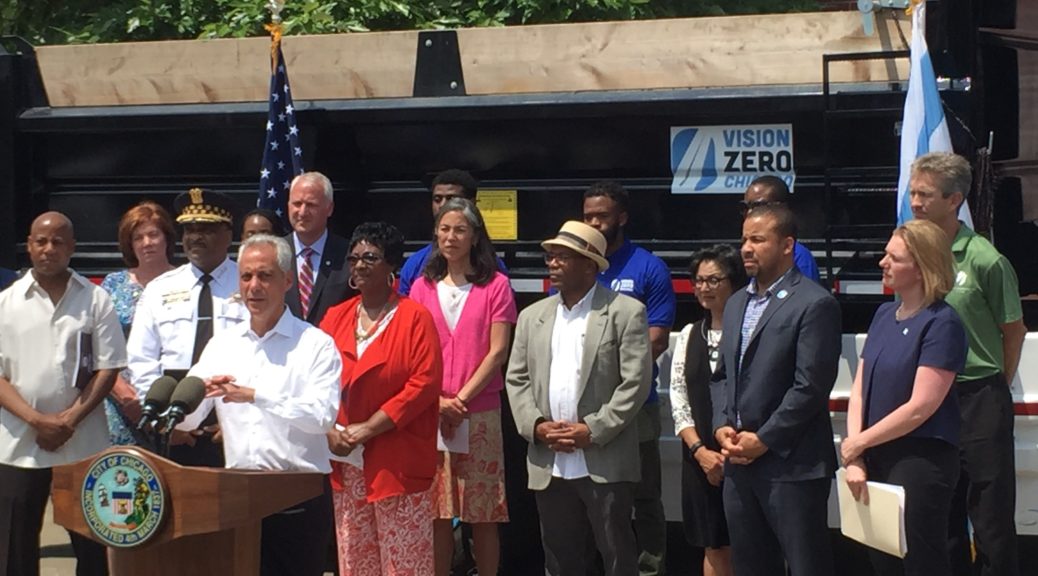
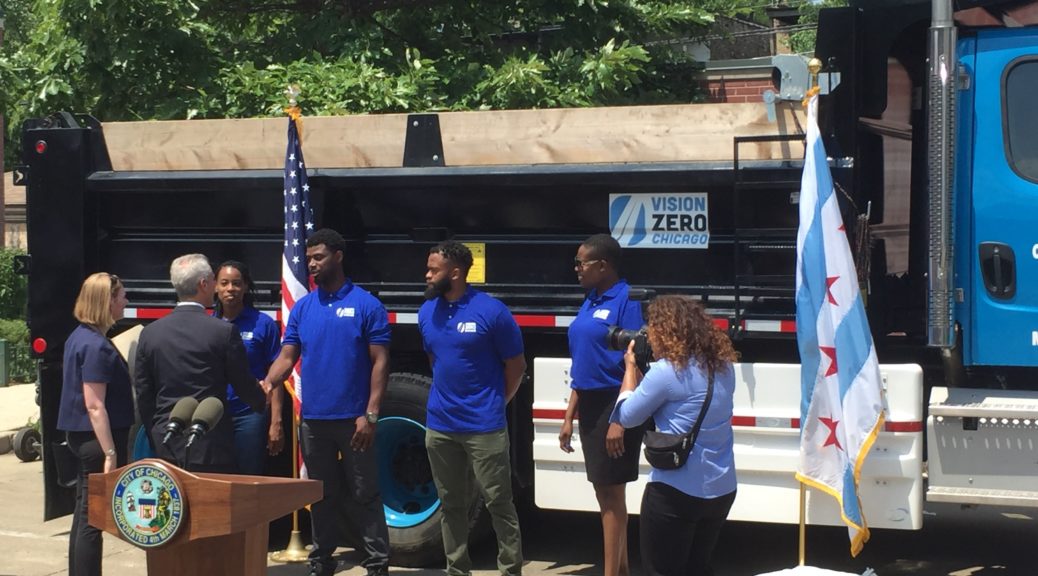
Last week, the Mayor’s Office announced the introduction of a truck safety ordinance to City Council as part of its renewed Vision Zero initiative.

The announcement represents the city following through on one of the commitments in the recently released Vision Zero Action Plan to eliminate all traffic fatalities in Chicago by 2026.

Contractors will be required to phase in the installation of safety equipment, starting on January 1, 2018, with full compliance required by January 1, 2021. The city is also committing to the same standards for their own fleet of trucks.

The equipment to be installed at the contractor’s expense includes mirrors to increase visibility of people walking and people biking for drivers, as well as lateral protective devices, also known as side guards, to decrease injury due to collision.

The Vision Zero campaign is supported by data that demonstrates traffic fatalities are preventable and the moral imperative that all traffic fatalities are unacceptable.

After six people biking were killed in crashes with commercial vehicles last summer, the need for a truck safety ordinance became even more painfully clear. Active Trans joined others in the bicycling community in calling on the city to strengthen its safety regulations for large vehicles.

According to the Chicago Department of Transportation, 33 pedestrians and cyclists have been killed by large vehicles on Chicago streets since 2010. If a truck is involved in a crash, the chance of a fatality triples.

The safety equipment required as part of the ordinance is proven to save lives. This ordinance will not just help create safer streets for bikers but also for pedestrians who are the most vulnerable roadway users.

Crash victim Dee Palagi, who spoke with Active Trans this past spring, told DNAinfo, “this [ordinance] should have already been in place. But it is a good thing moving forward.”

Although the timeline for the implementation for this ordinance is lengthy, it’s an important step in reducing the number of serious and fatal crashes involving large vehicles. Active Trans hopes private sector leaders will step up and install the equipment before it’s legally required, and we’ve spoken with companies interested in upgrading their fleets as soon as possible.
Creating a complete bike network in Edgewater

A groundbreaking bikeways project is starting up in Edgewater, which Active Trans hopes sets a precedent for all of Chicago’s neighborhoods.

This past week the Chicago Department of Transportation (CDOT) and the office of Alderman Harry Osterman of the 48th ward hosted a community meeting to kick off the conversation around the pilot program to create a neighborhood bikeways network for Edgewater.

The goal of the project is to create a well-connected neighborhood bike network designed for people of all ages and abilities.

The project will focus on identifying new east/west routes, building upon existing north/south routes, creating connections to schools, crossing major arterial avenues of Broadway, Clark Street, and Ashland Avenue, and closing other gaps in the existing neighborhood network.

What really sets this project apart is that funding is already in place to build all the newly identified bike routes at once. According to CDOT, construction is slated to take place in 2019.

This initiative marks a big step forward towards achieving the goal Active Trans is pursuing in our Bikeways for All Campaign: a seamless, equitable, and low-stress bike network throughout all of Chicago.

By investing in complete networks of “low-stress” bikeways, such as protected bike lanes, neighborhood greenways and urban trails, we know more people will be encouraged to use bikes as everyday transportation.

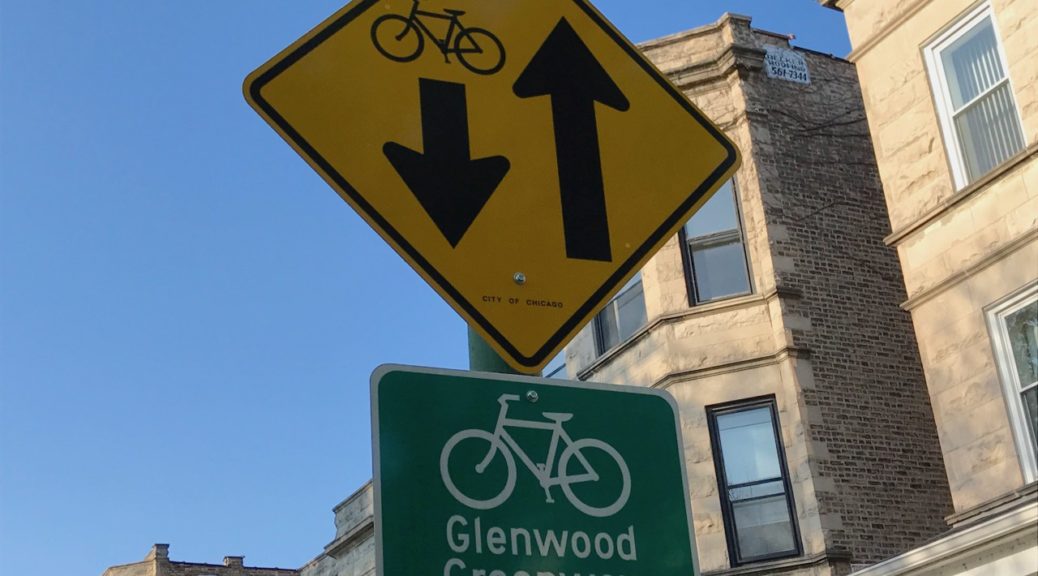
Examples of low-stress bikeways can already be found throughout Edgewater, including the new Glenwood Greenway and, of course, the Lakefront Trail. The task undertaken by this new project will be to fill in the gaps and stitch these individual pieces into a seamless whole.

Creating this seamless network will provide the neighborhood with countless health, economic, and environmental benefits. According to census data, up to six percent of Edgewater residents already commute by bike and twelve percent of households in the community are without a car, highlighting the immediate need for additional protected bike lanes and neighborhood greenways in the community.

In addition to benefiting the people already using bikes as transportation, low-stress bike networks are proven to encourage more people to get around on two wheels. This in turn increases physical activity, which helps prevent chronic diseases like diabetes. Getting more people biking also cuts down on greenhouse gas emissions and air pollution.

Better conditions for biking will also provide local businesses with a boost. That’s because research has shown that people who regularly bike and walk to commercial corridors spend more than people who drive.

It is hard to overstate the number of different benefits this project can bring Edgewater. For that reason, Active Trans would like to see this process replicated citywide. We hope this project can serve as an example to other wards looking to expand equitable access to multi-modal transportation.

So what happens now?

CDOT and Ald. Osterman’s office are looking for input on important destinations in the ward, routes that you use now, routes you want to use, barriers to biking and walking, opportunities for success, and programming ideas. If you have any comments or questions, please contact [email protected] or [email protected].

The project planning will move forward with an organized bike ride later in the summer, task force meetings in the summer and fall, and a second community meeting in the winter of 2017. After engineering coordination throughout 2018, construction is expected to begin in 2019.


City Trucks Will Install Guards To Protect Bicyclists, Pedestrians:

Large trucks working on big projects for the city would have to have side guards installed to prevent pedestrians and bicyclists from being run over by the truck’s rear wheels under a measure backed by Mayor Rahm Emanuel.

Trucks weighing more than 10,000 pounds working on projects worth more than $2 million would have to start installing side guards and convex mirrors in January and finish within three years, Emanuel announced.

“Chicago is using a data-driven approach to improve traffic safety, and the data shows we can save lives and prevent serious injuries by installing this type of safety equipment,” Emanuel said in a statement that noted that after officials in the United Kingdom required the guards, the number of pedestrians killed in side-impact collisions with trucks dropped 20 percent while the number of fatal bicycle accidents dropped 61 percent.

Chicago Department of Transportation Commissioner Rebekah Scheinfeld said the safety measures would lower the risk of crashes and make the impact of the crashes that do occur less severe.

“Side guards greatly mitigate the severity of side impact crashes, especially those involving pedestrians and bicycles,” Scheinfeld said. “And convex and crossover mirrors reduce blind spots for large vehicles.”

The measure, which is expected to be considered by the City Council next month, will also direct Fleet and Facilities Management Commissioner David Reynolds to begin installing the safety measures on city trucks.

In September, the Active Transportation Alliance told city officials there was “an urgent need to address the disproportionate threat these large vehicles pose to people biking and walking” after six bicyclists died after being struck by commercial vehicles.

Kyle Whitehead, the alliance’s government relations director, said Thursday he was pleased with the ordinance, although it won’t fully be in place until January 2021.

“Changes like these tend to take longer than anyone would like,” Whitehead said, adding that the group would continue to work with city officials to encourage private firms to install the guards and convex mirrors.

City officials have vowed to eliminate death and serious injuries from traffic crashes by 2026 as part of the mayor’s Vision Zero campaign.

Dee Palagi, 27, said she was relieved the city will require its trucks to have side guards — even though that wouldn’t have prevented her from suffering serious injuries when she was struck by a semi-truck while riding her bicycle near Roosevelt Road and Wood Street in September 2016.

Palagi, whose leg was amputated after her foot was pinned under the truck, said she hoped that the effort would prevent others from being injured or killed.

“This should have already been in place,” Palagi said. “But it is a good thing moving forward.”

High-Speed Train Between O’Hare, Downtown Has Elon Musk’s Interest: Rahm

Mayor Rahm Emanuel’s plan for a high-speed rail line between Downtown and O’Hare Airport got a jolt of electricity Monday with the news that Tesla founder Elon Musk may be interested in the project that the mayor has called “essential for the city’s future.”

Musk, who also founded SpaceX — which hopes to transport astronauts to the International Space Station — met with a team from the mayor’s office in Los Angeles recently about Musk’s drilling firm, the Boring Co., which may bid to build a nonstop underground rail line, Emanuel said Monday afternoon.

“[Musk] has expressed an interest in what Chicago is doing,” Emanuel said. “It would be a tremendous investment and job creator, an economic engine for the city that would pay dividends for decades ahead.”

Emanuel said he had invited Musk’s team to visit Chicago to see whether a tunnel makes sense for the O’Hare express train.

“The opportunity for the City of Chicago is endless and boundless,” Emanuel said, adding that it would benefit the Loop and airports. “I’m very excited about their interest.”

In 2016, Emanuel announced plans to pay $2 million to the Parsons Brinckerhoff design firm to come up with ideas for where Downtown and O’Hare stations might be located and the best and quickest route through the city.

Results of that effort have not been announced. It is unclear how much the project would cost, or how it would be paid for.

Several aldermen and transportation experts have been critical of the push for an express train to the airport, which already is connected to the Loop by the CTA Blue Line, which is itself in the midst of a $492 million renovation.

Musk’s interest in the O’Hare high-speed rail line was first reported by Crain’s Chicago Business.

Musk’s firm has developed a tunnel-drilling technology designed to cut construction costs by at least 90 percent by using drilling technology it invented to bore narrow tunnels.

Musk’s ability to drill narrow tunnels may be crucial to avoid disrupting the Blue Line tracks, the Metra tracks or the Kennedy Expy. — not to mention city neighborhoods.

Tickets on an express train — which would zoom from O’Hare to Downtown in 20 to 25 minutes — could cost $25 to $40, according to estimates, while a one-way fare on the Blue Line from O’Hare now costs $5.

Koch told Crain’s that Musk discussed a train featuring passenger cars smaller than CTA “L” cars that would leave as they fill up and travel at 125 mph. Musk also has touted a near-supersonic Hyperloop transport concept that could send passenger cars hurtling at 600 mph using vacuum pressure.

The Boring Co. is digging a tunnel from Los Angeles International Airport to Santa Monica, one of the worst stretches of Los Angeles’ always-clogged 405 freeway.

The city could ask firms — including Musk’s company — to bid on the project by the end of the year, officials said.

Milwaukee Ave. in Wicker Park in dire need of bike lanes

Milwaukee Avenue in Chicago’s Wicker Park Bucktown neighborhood is one of the busiest streets for walking and biking in the entire city and probably the entire Midwestern US. The street also sees an unacceptable number of people walking and biking injured in preventable crashes.

Let’s change that. Sign our petition calling for bike lanes and other safety improvements to Milwaukee Avenue in Wicker Park.

In the five years from 2011 and 2015, there were 195 crashes that resulted in people biking getting injured, there were 56 pedestrians injured, and one pedestrian fatality on this stretch of roadway. There were also 74 reported dooring crashes – 6 percent of the citywide total – according to the Chicago Department of Transportation.

Thousands of people continue to bike and walk through the corridor despite unsafe conditions. People biking represent 40 percent of peak-direction traffic – yet there are no bike lanes.

More than 5,000 people cross the Milwaukee/North/Damen intersection on foot during a.m. and p.m. peak hours – yet crosswalk markings are faded or missing altogether.

Sign our petition calling for bike lanes and other safety improvements to Milwaukee Avenue in Wicker Park.

The City of Chicago, local aldermen and the Wicker Park Bucktown Special Service Area are developing a project to make low-cost, near-term improvements for people walking and biking on Milwaukee Avenue.

We need to push them to go further and redesign the street so it prioritizes people over cars by adding bike lanes, new crosswalks and lowering the speed limit to 20 miles per hour.

Help make this happen. Sign our petition calling for bike lanes and other safety improvements to Milwaukee Avenue in Wicker Park.

After you sign the petition, be sure to RSVP for our 6/29 event to showcase support for street safety: Mobilizing for a Safer Milwaukee Avenue, hosted by our friends at Arc’teryx Chicago. We’ll have free beer courtesy of Revolution Brewing and more oppotunities to help us push for change!

Why Uber won’t replace public transit

Uber hasn’t had a great 2017 so far — what with employee allegations of a culture of sexual harassment, evidence that the company has been systematically deceiving government inspectors, and a lawsuit claiming that it stole autonomous vehicle technology from Google.

Nevertheless, the company remains the most celebrated tech disruptor du jour, and its seemingly ever-growing customer base has convinced many people that it represents the future of urban transportation.

And in fact, it (or something like it) may have a large role to play for years to come. But it will be as a partner to traditional transit services like buses and rail — not a replacement, as some have predicted.

Why? Three reasons: Equity, money and geometry.

Perhaps the most obvious objection to eliminating your local transit service and telling people to just whip out their smartphones is that not everyone has a smartphone. And even those who do are not necessarily in the position to pay for a daily Uber commute: while the company’s prices are usually below those of traditional taxis (more on that in a second), a trip of a couple miles might easily put you back $10, several times more than bus fare.

Beyond the issue of income, Uber’s vehicles aren’t necessarily accessible to people in wheelchairs. And while not all of the Chicago area’s legacy rail stations are accessible, all buses operated by the CTA and Pace are.

Second, despite its apparent success, Uber is losing money hand over fist: nearly a billion dollars in the fourth quarter of 2016 alone. Why? Because it’s using venture capital funds to keep its prices artificially low.

At some point, those investors are going to expect a return on their investment, and Uber will have to either raise prices substantially, cut back its service areas to the absolute densest trip-generating neighborhoods or some combination of both. At that point, many of the people who have been relying on Uber to get around will discover they’ve suddenly been marooned by a private company that — unlike a government — won’t respond to public pressure by reinstituting money-losing services.

But perhaps Uber will slip out of this conundrum. Maybe truly self-driving cars — ones that don’t require any human oversight — are closer than most experts expect, and Uber can fire all its drivers, save a boatload of money and keep prices down. Or maybe, as legal scholars like Yale’s David Schleicher expect, public opinion will lead governments to subsidize ride-hailing services as a kind of public-private paratransit. In fact, in a few places like Altamonte, Florida, that’s already beginning to happen.

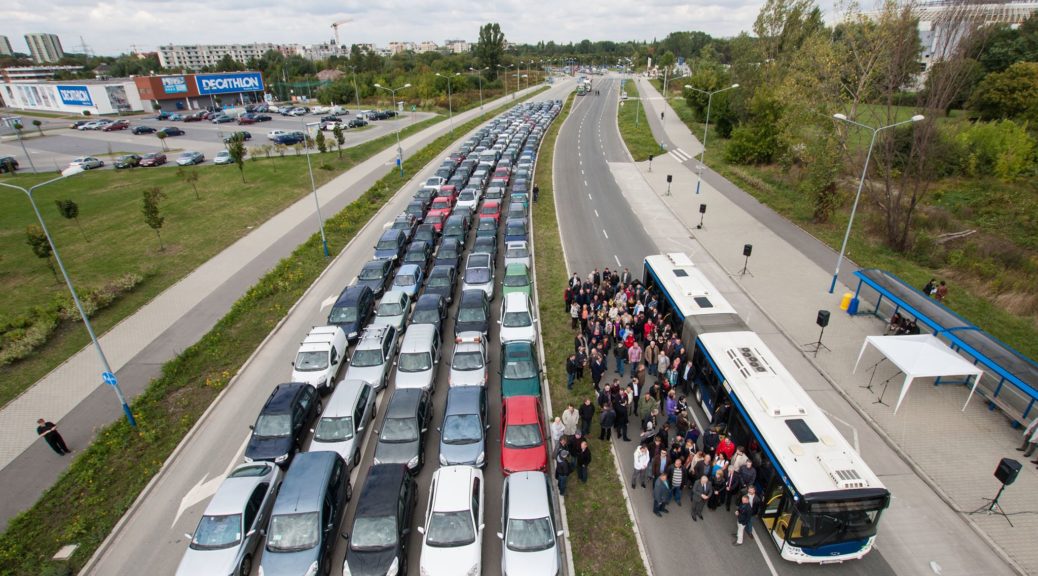
But even in those scenarios, Uber still can’t replace the bulk of traditional transit rides for one unavoidable reason: Geometry. Simply put, Uber’s vehicles are still automobiles, and they require massively more space per person than buses or trains. A packed L train can hold 123 people in one 48-foot car: even if they could somehow drive without any buffer space in between, you could only fit about three Honda Civics in the same amount of space. Assuming one driver and three passengers — a very generous assumption — that makes the L roughly 14 times more space-efficient.

A standard 40-foot bus is about 10 times more efficient. With two passengers per Uber, a full rush hour bus would require 40 Honda Civics to replace it — stretching down the street, bumper-to-bumper, for over 600 feet.

So even setting aside equity and the fact that Uber is enormously unprofitable, shifting people from high-capacity transit to ride-hailing services is a recipe for unimaginable gridlock. Our streets and highways simply don’t have the room. For the foreseeable future, public transit is here to stay.

This is a guest post authored by Daniel Kay Hertz, who writes about urban issues for various national and local publications.

Photo credit: Solaris Bus and Coach

Uber Adds In-App Tipping For Chicago Drivers

You’ll soon be able to tip your Uber driver in Chicago.

Uber, which allows people to hail rides through an app, is rolling out an update that will allow people to tip their drivers after a trip. Drivers were not able to accept tips through the app previously.

Riders will be able to give drivers preset tips of $1, $2 or $5, or they can enter a custom amount through the app. Users will have up to 30 days after a ride to tip their driver.

Tipping will be optional “but always appreciated,” according to Uber’s website, and no service fees will be added on to the tip.

The service is already available in Seattle, Minneapolis and Houston, but Uber hopes to have it in every city — including Chicago — by the end of July.

Tipping will also be available for those who use UberEats, a food-delivery service with Uber drivers.

Western Overpass Project Is Almost Done — But One More Lane Closure Coming

Time to dig deep, motorists, and gut out one more lane closure as the Western-Belmont overpass replacement project nears the finish line.

Final paving of the stretch of Western Avenue between Waveland and the Chicago River bridge, including Belmont, is set for next week, with traffic reduced to a single lane in each direction while crews lay down fresh asphalt.

The work will be done during off-peak hours, 9 p.m. to 6 a.m., over the course of four to five nights weather permitting, according to the Chicago Department of Transportation.

Drivers should expect delays and are encouraged to use alternate routes.

The stretch of Western from the river bridge south to Diversey is tentatively set for paving June 27 through July 1, according to an update from Ald. Deb Mell (33rd).

After a break for the Fourth of July holiday weekend, daytime single lane closures on Western Avenue will continue into August to allow for final pavement markings, miscellaneous finish work and punch list items.

Once the project is completed, three lanes of traffic will be open in each direction on Western Avenue during rush hours.

Demolition of the former Western-Belmont overpass, which was built in 1961 to relieve congestion around the former Riverview Amusement Park, began in March 2016.

Drivers will no longer sail over the Western-Belmont-Clybourn junction, but will instead converge on a five-leg grade-level intersection.

Prepaid Bus-Boarding Coming To Lakeview LSD Stop, 69th St. Red Line Station

The CTA is testing prepaid bus-boarding at two new locations in hopes of reducing lines and getting buses moving faster.

The two stops affected are:

• The 69th Street Red Line station between 3 p.m. to 6 p.m. weekdays for the westbound No. 67 (67th/69th/71st) and southbound No. 29 (State Street).

• Inner Lake Shore Drive and Belmont in Lakeview between 6:30 a.m. and 9:30 a.m. weekdays for the southbound No. 146 (Inner Drive/Michigan Express) and No. 135 (Clarendon/LaSalle Express).

The pilot is expected to run for at least four months.

“By piloting prepaid boarding at select locations, customers can pay fares in advance and board buses much like they do boarding the ‘L’ — which gets customers to their destinations more efficiently and reduces delays that occur during busy rush periods,” a statement from CTA said.

The prepaid system lets riders tap their fare cards to enter a designated “paid” waiting area, and when the bus arrives, they board freely, similar to the rail system.

Last year, CTA tested prepaid bus service at the Belmont Blue Line station and at the Madison and Dearborn Loop Link station.

The Belmont test lasted for a year and found that prepaid boarding saved an average of 38 seconds per bus trip, said CTA spokeswoman Irene Ferradaz. Permanent prepaid service is being considered as part of a planned redesign of the station.

In the Loop Link test, the CTA found a savings of 16 seconds per bus. The CTA hasn’t decided whether prepaid bus fares will become permanent in the Loop.

Vision Zero Action Plan focuses on reducing vehicle speeds

Today’s release of a Vision Zero Action Plan lays a strong foundation for the city to achieve its goal of eliminating traffic fatalities and serious injuries by 2026.

The three-year plan shows the city is serious about preventing crashes and making our streets safer for everyone, especially the most vulnerable people who are walking and biking. Now we need to make sure our elected officials at every level of government provide appropriate funding support for the city to meet its ambitious goals.

We’re advocating at the local, state, and federal levels for more safe streets funding, especially for infrastructure projects on streets that have long been identified as high-crash corridors. Redesigning these streets will be pivotal to bringing down our unacceptably high numbers of fatal and serious injury crashes.

Last week we released a regional crash report breaking down the most recent traffic crash, fatality, and serious injury statistics. In 2015 the City of Chicago saw 119 traffic fatalities and 21,668 injuries from traffic crashes.

The plan identifies driver speed as the most important factor in determining crash risk and severity. The city can manage speed by redesigning streets to calm traffic and enforcing appropriate speed limits.

In policy recommendations to the city, Active Trans called for the city to evaluate speed limits on different types of streets and consider reducing the default speed limit, especially in corridors that have been prioritized for people walking, biking, and riding transit.

In the plan the city commits to evaluating city speeds and making recommendations on changes within the three-year timeframe.

The plan also includes a goal to pass an ordinance requiring trucks to install side guards and safety mirrors to prevent serious injury or death resulting from collisions with people biking and walking. The regulation would apply to the city’s own fleet in addition to city contractors, while encouraging compliance from private companies.

Commercial vehicle regulation became a priority in the advocacy community after several tragic crash fatalities in recent years.

Active Trans worked with crash victim Dee Palagi, who was who was struck by a semi-truck while bicycling in West Town and had to have her leg amputated. Dee says new regulations could help prevent serious injury and save lives in crashes like hers.

Vision Zero has been one of Active Trans’ top priorities for several years. In 2015 Active Trans was joined by physicians, traffic safety experts and victims of traffic crashes in calling on the city to develop a Vision Zero Action Plan that brings all city agencies to the table. Last year the city established a task force and began work on the plan.